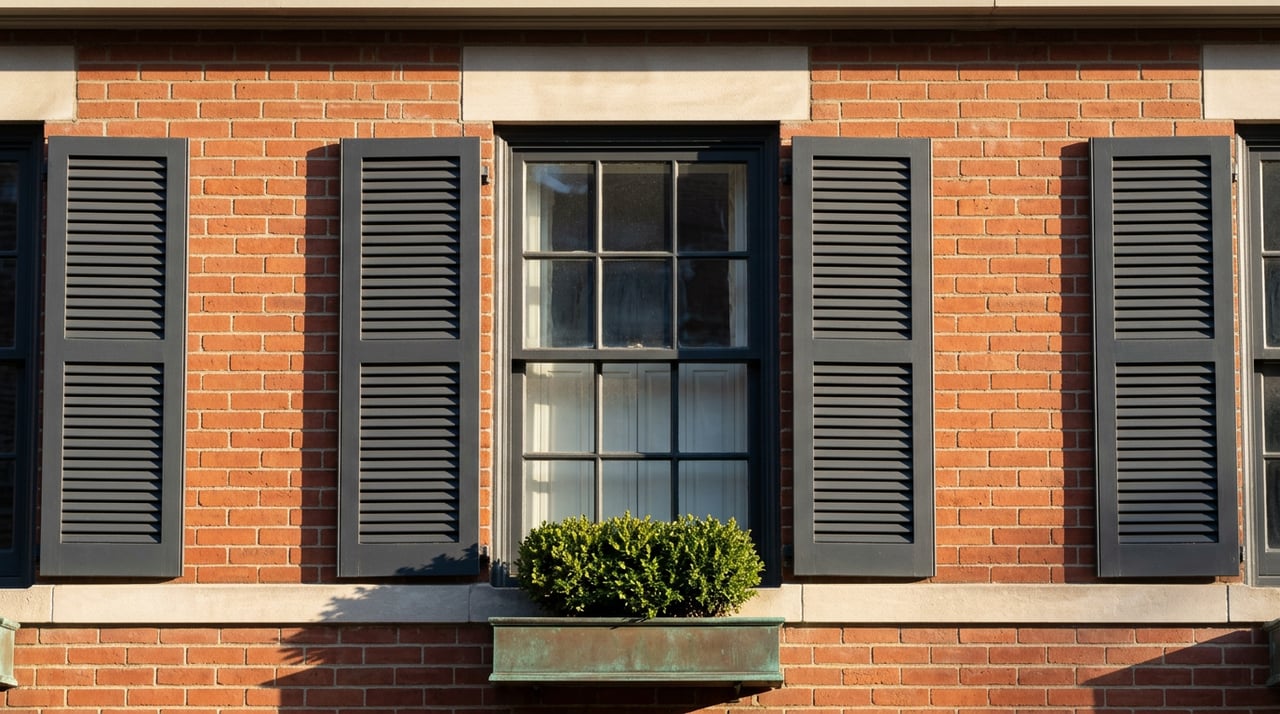
Two rowhouses sit two doors apart on the same Old Town block. Same brick, same depth, same asking price range, same sagging single-pane windows a buyer would want to replace in year one. One owner gets staff sign-off on new windows within days. The other spends months preparing for a public hearing, and may be told the historic sashes have to be repaired, not replaced, no matter how drafty they are.
The difference isn't the house. It's the year the house was built, and which wall the windows sit on.
That distinction, not the purchase price, is the number every renovation-minded buyer in Old Town Alexandria should be pricing into an offer. The City's Board of Architectural Review doesn't evaluate projects by what a buyer wants to do. It evaluates them by a set of dividing lines that split nearly identical-looking homes into completely different approval tracks.
The Line That Actually Splits Old Town in Two
Old Town Alexandria has two locally regulated historic districts: the Old and Historic Alexandria District, which covers most of what people picture when they say "Old Town," and the Parker-Gray District, which covers the historically Black Uptown neighborhood. Both fall under the Board of Architectural Review, and both require a Certificate of Appropriateness, or an administrative approval, before the City will issue a building permit for exterior work.
Inside Parker-Gray specifically, the rules split further by construction date. Buildings from before 1932 are classified as "early." Buildings from 1931 onward are classified as "later," and they're held to a lighter standard. Then there's a second split by elevation: street-facing walls get the closest scrutiny, side and rear walls get more latitude, and anything more than 15 feet from the front property line for post-1931 buildings can often skip review altogether.
Stack those two lines on top of each other and you get four categories of the exact same architectural feature, each with a different approval path. A front-facing window on a pre-1932 house has to be repaired, not replaced, if it's original. A rear window on that same house has real flexibility on material and configuration. A front window on a house built in 1938 has more room to change size and sash pattern than its older neighbor. None of this is visible on a listing sheet. It's determined entirely by a plat date and a compass direction.
Interior work doesn't touch any of this. Kitchens, baths, floor plans, and mechanical systems inside the walls are governed by ordinary building, electrical, and plumbing permits from the City's Department of Code Administration, the same as anywhere else in Alexandria. The BAR only has jurisdiction over what's visible from a public street, alley, or the waterfront promenade.
What Fast-Tracks and What Doesn't
The City's process has two speeds, and knowing which one your project falls into changes your renovation math before you've even closed.
Administrative approval covers minor, low-impact work: repainting in the same color, replacing roofing with a similar material, routine maintenance, and select window and shutter work that meets the published guidelines. These applications go to preservation staff, not the full board, and can be approved in a matter of business days once the file is complete.
Full BAR review covers anything that could change the historic character of the district: additions, new construction, demolitions, and significant alterations to visible exterior features. These require a staff completeness review, public notice, and a hearing at a scheduled board meeting, which the board holds on the first and third Wednesday of most months. Realistic turnaround for a hearing-track approval runs roughly one to two months from submission to decision, and many window and door projects take two to four months from concept to permit once design, documentation, and scheduling are factored in.
There's one more detail worth knowing before you fall in love with a fixer-upper: if the Board denies an application, that same case cannot come back before the Board for a full year. A renovation plan that gets rejected at a hearing isn't a setback to redesign around next month. It's a delay measured in seasons.
Any demolition or "capsulation" of more than 25 square feet of exterior material also requires a Permit to Demolish, regardless of whether that material is visible from the street. A buyer planning to strip old siding down to the studs on a rear addition needs to account for that threshold even on a wall nobody driving by will ever see.
The Board is a seven-member committee appointed by City Council, empowered to regulate changes that affect exteriors of structures in the locally regulated historic districts, and when it denies a Certificate of Appropriateness, the same case can't be reheard for a year.
The Rulebook Is Being Rewritten This Fall
Here's the part that makes this a moving target rather than a fixed reference: the City is actively rewriting the guidelines that govern all of the above, right now, in the final months of 2026.
On August 19, Alexandria's Historic Preservation Division held a well-attended community meeting at the Nannie J. Lee Community Center to walk residents through proposed updates to 11 chapters of the Design Guidelines covering both the Old and Historic Alexandria District and Parker-Gray. Preservation planner Brendan Harris led the presentation, joined by principal planner Julie Weisgerber and preservation architect Bill Conkey. The stated goals were faster approvals, clearer terminology, and closer alignment between the two districts, including a proposal to formally distinguish "street-facing" from "non-street-facing" elevations to reduce confusion during review. Public comment on the draft chapters runs through September 2.
Separately, the City held a community meeting on September 9 on proposed changes to Article X of the zoning ordinance, the section that governs the historic districts more broadly. Planning and Zoning staff are reviewing how the BAR handles development special use permit projects, curb cut applications, and ATM placement in the historic districts, among other items, as part of a review that began in fall 2025.
Neither meeting has produced a final ordinance yet. A buyer under contract on a historic Old Town property this fall is negotiating against a rulebook that could look different by the time a permit application is filed next year. If a stated goal of the rewrite is bringing Parker-Gray standards closer to Old Town standards, the classification gap described above, the one that currently separates a fast administrative approval from a multi-month hearing, is one of the things actively being reconsidered.
What to Check Before You Write the Offer
For a buyer weighing a historic Old Town property against a comparable non-historic one nearby, three checks turn this from an abstraction into a number you can actually put in a budget:
- Confirm which district the property sits in, whether it's classified as pre-1932 or post-1931 if it's in Parker-Gray, and which elevations face a public street. Preservation staff can confirm this before you're under contract, and it's a faster question to ask than to guess.
- Separate your renovation wish list into interior work, which moves at ordinary permit speed, and exterior work, which doesn't. A kitchen gut can proceed on a normal contractor's timeline. New front windows on a pre-1932 facade cannot.
- If the property sits inside an HOA, as several Old Town communities do, plan for a second layer of architectural review on top of the City's. Securing HOA sign-off early keeps that timeline from stacking silently behind the BAR's.
None of this makes a historic Old Town home a harder buy than a newer one elsewhere in the metro area. It makes it a different kind of buy, one where the calendar is as much a part of the deal as the price. Buyers who ask these questions before closing write offers with realistic timelines built in. Buyers who don't tend to find out the hard way, usually right after they've already priced out new windows.
If you're weighing a historic Old Town property, or comparing it against a newer build elsewhere in the DC metro area, the Dawn Wilson Group can walk through what a specific address's classification means for your renovation plans before you write the offer. Let's connect and schedule a consultation.
A Few Questions Worth Asking Early
Does exterior paint color always require BAR approval? Not always. Repainting a surface that's already painted generally doesn't require a permit, but painting previously unpainted masonry does, and major color changes on visible elevations can trigger review.
Can I add solar panels to a historic Old Town home? Solar can be approved when it's placed to minimize visibility from the street, such as on a rear roof slope or set back from the front elevation, with mounting details coordinated to avoid damaging historic material.
Does a historic designation affect homes that aren't in Old Town proper? Yes. Properties elsewhere in Alexandria designated as "One Hundred-Year-Old Buildings" fall under BAR oversight too, even outside the two local historic districts, though not every building of that age carries the designation.